Free Word Count Tracker for Your Blog or Website
free online word count tracker

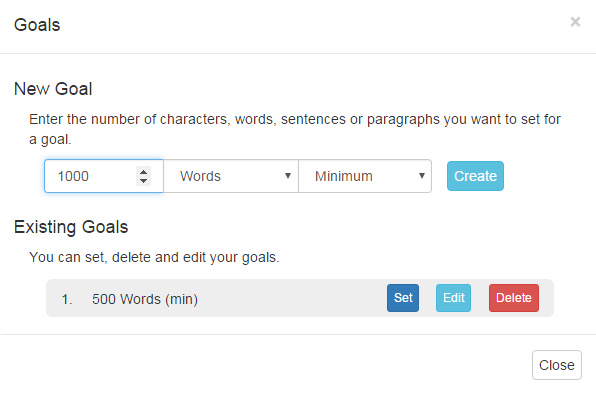
One of the popular features on WordCounter is the goal setter (button right above the text input area). This allows users to set a word count goal which allows them to see their progress toward that goal as they type into the text area. What a lot of people don’t notice is that there is actually a way to embed this counter into a website or blog allowing others to also see how you’re progressing on your word count goals.

To embed the free word count tracker, all you need to do is click on the earth icon to the right of the tracker once you have set a goal. Hovering over this icon, you’ll see the words “Embed this!” Once you click on it, you’ll be given a couple of choices on the appearance of your word count tracker. You can choose the size (small, medium or large) and the color (blue, red, green, yellow, pink, cyan, brown, purple or orange). Once you’ve made these two choices, you simply click on the “save and get code” button. This will give you code that you can then place on your blog or website.

One of the advantages of this word count tracker is you never have to manually input the number of words you have written to update the counter. As you add words to your writing in the text area on WordCounter, the tracker will automatically update. This allows others to know how you’re doing in real time toward your writing goals.

There are a couple of ways you might want to use this. For example, if you write blog articles and you have a daily goal of writing 1000 words a day, you can begin writing each day and people will be able to see where you’re at during the course of the day (and whether you meet your goal). Then you can begin from zero the next morning and continue to repeat day after day.

If you have a longer piece of writing, you can set the goal as much larger. For example, maybe your goal is to write 50,000 words for a single project. You can set up the tracker for this amount and everyone will be able to see how your are progressing toward the longer-term goal.

No matter how you choose to use the word count tracker, it’s a great way to keep you accountable to the writing goals you set for yourself. Stating your writing goals and placing them out there so all can see is a great way to keep yourself honest, and it can be a great motivator to write on a daily basis. If you truly want to get a good amount of writing done daily (or over a longer period of time) using one of these trackers is an excellent way to do so.

I usually have a minimum writing goal of 500 words a day, although I sometimes increase it for certain periods when I need to be extra productive. You can see the tracker I use below.

Just go to the main page to get started.
365 Day First Book Writing Challenge: How to Write a Book in a Year

How to write a book in one year
You have decided you want to write a book in the next year. That’s great, but now you need to come up with a plan to make that happen that’s simple enough to help you reach the goal, yet allows you to write enough to complete a book within a year. One easy and effective way to accomplish the book-in-a-year goal is to take the 365-day book writing challenge.

The concept of this challenge is simple enough that any writer, no matter what their level, should be able to follow it to reach their goal. Most people who decide they want to write a book fail because they try to do too much in too little amount of time. This challenge leverages the fact there are 365 days in a year and that you want to build a daily writing habit.

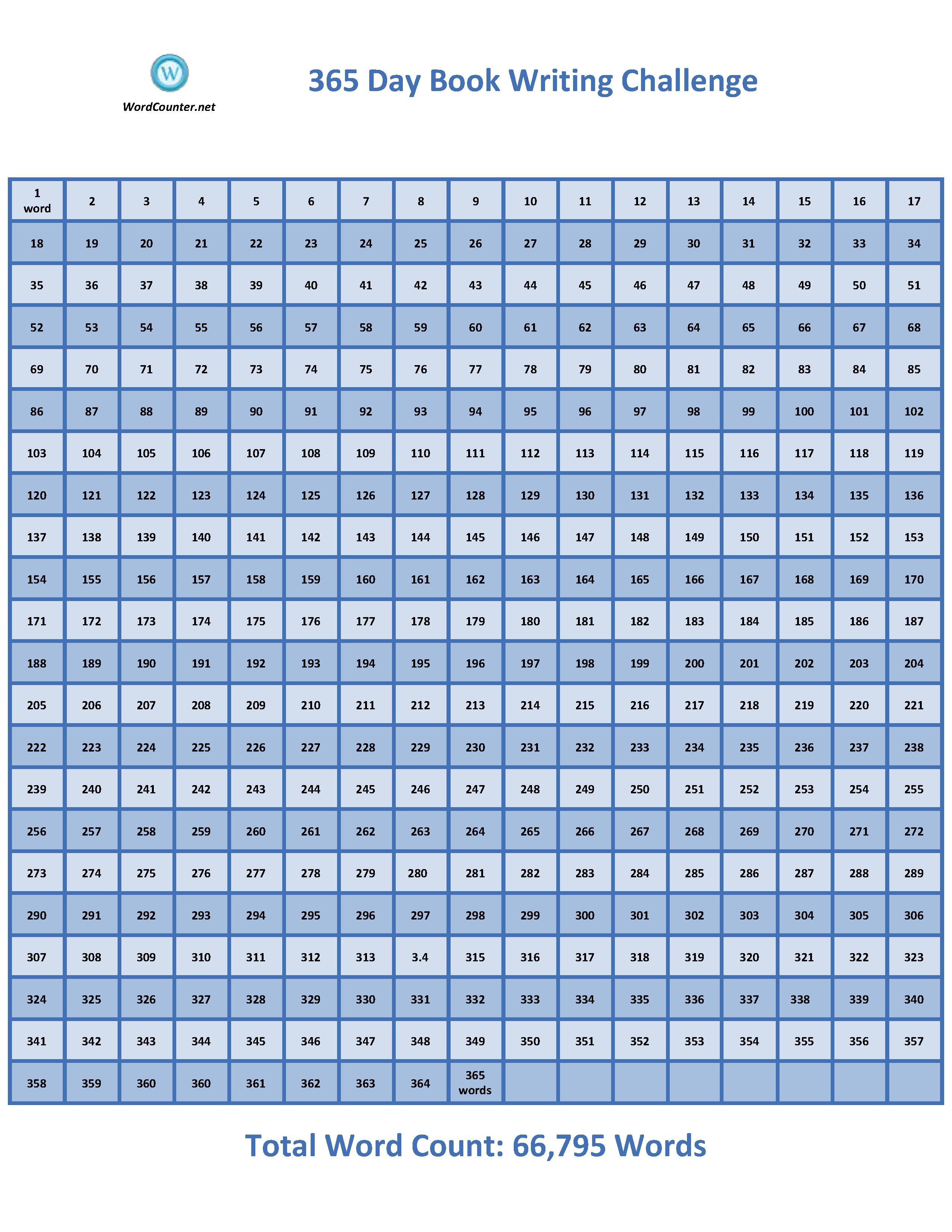
The book writing challenge works in the following way. Once you decide to begin, each day you need to write between one and 365 words. You want to shoot for writing the highest number of words you can to cross the highest number off the chart, but as long as you write any number of words which corresponds with a number that’s still available on the chart, you’re golden. At the end of the day, you place an “x” on the chart over the number of words you wrote that day. Each day you do this for the entire year and at the end, you will have written 66,795 words. Even more importantly, you’ll have established a daily writing habit which you can then use to write your next book in even less time.

365 Day Book Writing Challenge (click on image to print PDF)

Write a book in a year
To be successful in this challenge, there are a few important steps you should take. First, you should print out the challenge sheet. Once done, you should put it somewhere where you’ll see it daily. Tape it to the top of your laptop computer or hang it on the bulletin board above your writing desk. The chart needs to be visible so you are reminded each day you need to write, even if it’s only a little bit. This visual reminder will help you reach your daily goal of writing and the ultimate goal of finishing your book.

The second rule is you aren’t allowed to go to bed until you have crossed off one of the numbers on the sheet. There really is no excuse not to cross off one of the numbers. The truth is that if you are unable to cross off a number each day of the year with all of the smaller word counts available, you’re not serious about writing the book. In a way, it’s a test to determine if you are willing to take the actions necessary to write the book, or if you just say you want to, but it’s only words. That may sound a bit harsh, but if you can’t write a few words each day no matter what happens in life, writing the book isn’t a priority in your life. The only thing that can keep you from completing this challenge is yourself.

Another key about this challenge which increases your likelihood of success is that it takes into account the reality of life. There are going to be busy days and days when the unexpected happens and you won’t be able to write as much as you hoped. You should always shoot for the highest word count number still available on the sheet, but when a day comes when that isn’t possible, crossing off a smaller number is perfectly acceptable.

While having a book written at the end of the year is a huge deal, the biggest benefit of this challenge is something you’ll gain that’s far more important. This challenge requires you to write every day. Even the days when you’re only able to write a word or two, you must sit down and write something. That daily writing will turn into a daily routine by the end of the year. Once you have established that habit, you have created a foundation which will allow you to write far more the following year.

If you have had the goal to write a book in the past but have failed in getting it done, I encourage you to try the 365-day book writing challenge. It has a lot of things going for it that other challenges don’t, which increases the likelihood you’ll actually complete it and reach your goal. Best of all, at the end of the year, you’ll have a book written and you’ll have the skill-set in place to write as many more as you want to in the future.

1000 Words a Day Writing Challenge

write 1000 words a day challenge

If you find yourself in a position where you aren’t writing as much as you would like to, a great way to push yourself to do more is to do a 1000-words-a-day challenge. The actual number of words you choose to try to write daily doesn’t have to be 1000. It can be any number that fits your writing goal, and it can be higher or lower depending on your circumstances. 1000 words a day is a good starting numner if you aren’t sure how much you have been writing.

If you have taken one of these challenges in the past, you may not have managed to complete it. What often happens is a writer sets a daily goal, but something happens one day which prevents them from achieving the number of words they set. They then try to make up for the words they failed to write the previous day in addition to their normal daily goal. The result is many get behind to the point where they don’t feel they can make up for the past days and quit. This is a complete shame because, in many cases, they were still writing more than they were before the challenge, just not their predetermined goal.

There is a simple solution to this which will greatly increase your chances of completing the challenge without quitting in the middle. In addition to your daily goal, you want to set an absolute minimum number of words you will write each day. A good number for this is 10% of you daily word goal. For example, if you want to write 1000 words a day, the absolute minimum you will write in a day would be 100 words. While this may seem like a silly little thing, it can make a huge difference when it comes to the way you process the challenge.

The biggest change is that it redefines failure. Instead of failing by not writing 1000 words, you only fail if you don’t write 100 words. If you can’t write 100 words one day during the challenge, then one of two issues is going on. You either aren’t truly committed to writing 1000 words a day, or 1000 words a day is too ambitious a goal for you.

The 100-word minimum is a failsafe. Again, if you are barely making 100 words each day, then your original goal of 1000 was unrealistic. This minimum should only come into play when something unexpected happens to prevent you from writing, not because of writer’s block. What it allows you to do is to be disappointed you didn’t reach 1000 words one day without thinking you failed the overall challenge. It also means you don’t have to make up the words the next day. It keeps the challenge going instead of giving you an excuse to quit.

So why have a daily minimum number of words at all? Having that daily minimum number means that no matter how hectic a day may get, you have made writing a big enough priority that somehow, someway, you’ll find 10 minutes to sit down to write those 100 words. It also prevents you from beginning to form the bad habit of having days where you don’t write at all, and reinforce the habit that no matter what, you will write at least a little bit each and every day. This will help to reinforce the fact that writing is a priority in your life, and something you are determined to do on a daily basis.

Below are the steps you need to take to set up your challenge:

Step one: Determine the goal of how many words you want to write each day.

Step two: Determine the minimum number of words you must write each day (10% of your goal amount is a good number).

Step three: Determine the length of the challenge. It could be a month, 100 days, six months or a year — whatever best fits your circumstances. If you are trying this for the first time, a month is a good place to begin.

Step four: Determine if there are any off days. Some people may not have any at all while some may exclude weekends or one particular day each week. Again, make the challenge fit best to your particular circumstances.

Step five: Let others know about the challenge to keep yourself honest. When you let others know you are attempting a challenge, even if it’s only your family, you usually make a more concerted commitment, and hold yourself more accountable, than if you don’t tell anyone else. it’s harder to quit when you’ve stated to others what you’re going to do.

Step six: Keep track of your daily word count throughout the challenge, and record it somewhere. If you’re truly committed to reaching your daily word count goal, you’ll find the challenge will greatly increase the amount you’re able to write on a daily basis, and over the length of the entire challenge.

(Photo courtesy of Andres Nieto Porras)

>