25 Excuses for Not Writing (And Why They’re Not Valid)

writing excuses

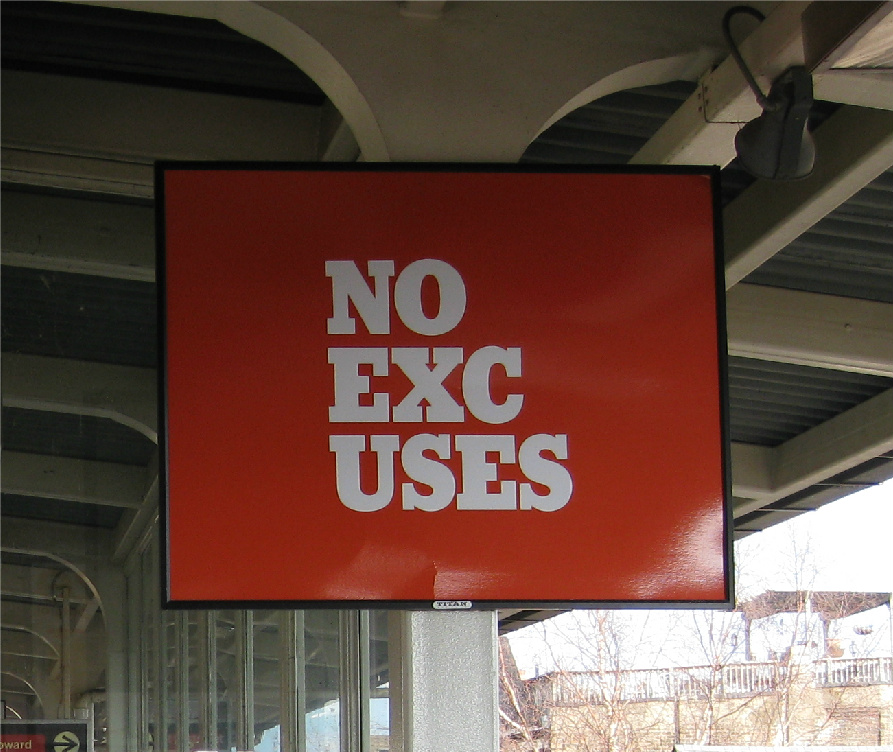
Writers (and those who want to be writers) have tons of excuses for not writing. I’m not sure there’s any other occupation with quite so many excuses for not working as writing. Everyone from school kids who have to write a term paper to novelists and freelance writers have piles of excuses for not doing the work.

Worse, many writers and would-be-writers have convinced themselves that these excuses are valid. While some of them may be valid on a limited basis (if you’re sick, injured, or in the middle of some kind of true crisis, for example, you may really not be able to write), most of them are just ways we try to justify our fears, insecurities, or laziness. They’re nothing but excuses, not legitimate reasons for skipping work. To help you sort out valid from invalid excuses, here are some of the most common excuses writers give for not working and why most of them are garbage.

I don’t have time

Everybody’s busy. We all have errands to run, jobs to do, family to take care of, volunteer assignments, and appointments to keep. If everyone was “too busy” to write, we’d never have another book published. If writing is something you want to do, you have to make it a priority. Drop whatever obligations you can get out of, delegate stuff to other people, and let the dishes sit in the sink for a little longer.

My family will hate me

This excuse comes up on two fronts. The first is that your family will hate you if you use real-life experiences in your work. They won’t like seeing themselves in print. And they probably won’t. But you can change names and alter events to protect the innocent. If they still get mad, well, you can hope that your royalty checks are enough to shut them up. The second fear is that your family will hate you if you start making writing a priority in your life. They may not get as much time as they’re used to and they might (gasp) have to start doing some more things for themselves. That’s not a bad thing. You can work out compromises as you go along to make sure they don’t feel left out.

I’m too old to start

“You can’t get published if you’re over forty. Publishers only want hot young authors who are TV worthy.” Or, “They won’t take a chance on an old guy who won’t live to give them thirty books.” Sometimes this is (sadly) true. But it’s even more true that publishers are businesses that want excellent products to sell. If you’ve got a great story well told or an original non-fiction book, they’ll want it, even if you’ve got one foot in the grave and it’s the only book you’re likely to ever write.

I’m too young to start

Yes, sometimes young authors lack experience and training and that comes through in their work, leading to rejections. But the younger you are when you start the learning process, the longer and more successful your career can be.

No one will take me seriously

They may not. Your work may be ridiculed and pushed aside. Or it may not. You won’t know unless you try. And unless your goal is to be a great literary author or the author of a serious non-fiction book, being taken seriously doesn’t matter all that much, anyway.

I’ve got writer’s block

There is no such thing as writer’s block. If you can’t think of a single thing to put on the page, you’ve got a very big problem and it probably means you’ve gone blind, deaf, and mute as well. With everything that goes on around you every day and all that has happened in your life, you should always be able to find something to write about. Whether what you write is good or not is a separate problem, but it’s not writer’s block.

It’ll never be published

Maybe not, but is publication the only reason you want to write? Do you want to write because you enjoy it, because you like to tell stories, or because you like to learn new things? If so, so what if you don’t get published? Writing is often its own reward and publication is just icing on the cake.

I have no talent

You may not. Lots of people don’t. But anyone can learn to write better. Spend some time in classes and working with a good writer’s group or mentor. You can get better. It may not be so much a lack of talent as you just don’t know the mechanics very well. At least try to improve before you write yourself off as a no-talent hack.

I’m saving it for when I retire/have more free time/the kids are gone

Sure. And something else will always insert itself into that, “free time.” Besides, what if you drop dead before you can retire, or what if the kids never leave? You have to write now, not put it off to some point in the future that may never come.

I don’t have any good ideas

Ideas are all over the place, you just have to learn how to recognize them and then turn that tiny fragment of an idea into a story or article. Everything that you read, watch, see, hear, or smell has the potential to be a good idea.

There are too many interruptions

You can move your work area to someplace less distracting like the library. Turn off the phone and refuse to answer the door. Buy some noise-canceling headphones. Turn off your internet connection and email notifications. If the kids won’t leave you alone, drop them off at the movies for a couple of hours. Dump them on your spouse for the afternoon and go to the library. Distractions can be managed if you’re motivated.

I need an MFA before I can write

Yes, you might need some more training before your work is publishable. Chances are, though, that you can learn what you need through an extension course or by working with a writer’s group and by practicing on your own. An MFA is nice, but very few people “need” one at all, much less need to complete one before they can write at all. After all, if you can’t write without it, how are you going to get into the program in the first place?

The last thing I wrote was rejected

Every writer is rejected. Most of them get rejected a lot. Even writers that are now legends like J.K. Rowling were rejected. It’s not always a matter of your work being bad. Sometimes it’s just that the particular publisher didn’t need what you’re selling, or that they already have something similar on their list. You have to keep writing and submitting.

There’s not a market for what I want to write

True, it can be harder to get work published that doesn’t fit into an established genre. But someone has to be the first to start a new trend. It could be you.

I’m too tired and stressed

Then get your life under control. Go to bed earlier. Try writing in the morning while you’re still fresh. Drop some obligations to reduce your stress. Figure out what’s stressing you and then work to eliminate or control it. Exercise to burn off some anger and increase your energy levels. Eat right to keep your overall health in balance. Everyone is tired and stressed but you have to learn how to get things under control so that you can be productive.

People will laugh at me

They might. Generally, though, most people are too absorbed in themselves to care about what you’re doing. And no publisher or agent is going to call you up and laugh at your submission to your face. They’re too busy to bother laughing at you. You’ll just get a polite rejection with no laughter.

The whole thing is just too hard

If it’s just too hard to write and go through the process of submitting and revising your work, you’re in the wrong line of work. Writing is a job and, like any job, it’s not easy. If it were easy, we’d all be getting six-figure royalty checks.

I’ll never finish, so why start?

This speaks to a problem with completion. Do you finish other things you start? If so, then writing just isn’t important enough to you to finish. Think about whether it’s something you want to do. If you never finish anything, then you’ve got a bigger problem you have to solve before you can write or do anything else successfully. Regardless, starting is worthwhile because you might discover that this is the one thing you do finish.

I’d rather be doing something else

Then go do it. Writing is either important enough to you that you will forego other activities, or it’s not. If you don’t want to do it, don’t. If you want to write, you’ll put your butt in the chair and do the work. Otherwise you’ll go to the movies and let other people’s work populate the bookshelves.

I don’t know how to get published

A lot of people don’t, but they learn. There are plenty of books and magazines to help you and in the age of the Internet, the answer to any question is one Google away. There are also extension classes dedicated to the publishing process. Write the story or book first, then worry about what comes next.

I have nothing new to say

If everything on the market had to be 100% original, we could all stop writing right now. There is very little that hasn’t already been covered. What matters is how you present your material. Is your voice unique? Do you have a slightly different angle on an old problem? Can you improve on something someone has already done?

I’m not an expert on anything

You don’t have to be. You can learn what you need to know as you go along. Sure, publishers like people who are well established in their fields, but you have a chance even if you’re not that guy. If you are professional and have something original to say, you can find work. And you can make yourself an expert. Start writing for smaller publications and work your way up. By the time you get to the upper echelon of publications, you’ll be an expert.

I’m not web savvy

It helps if you know how to set up a blog or website, and if you can promote yourself on Facebook and Twitter. But you can either learn these things as you go along, or hire someone to handle them for you. There are plenty of writers who pay someone to maintain their websites or presence on social media. There are also plenty of writers who’ve gone to classes to learn about these things.

I can’t handle failure (or success)

And if you never write, you won’t have to, now will you? That’s the allure of this excuse. But if you can’t handle failure or success in your writing, how can you handle anything that happens to you? Do you freak out if you get promoted at work? Probably not. Are you reduced to despondency if your dinner party doesn’t turn out the way you hoped? Probably not. The good news is that failure or success in writing is rarely life-threatening. So your story doesn’t get published? You had a good time writing it, didn’t you? And you probably weren’t counting on the money just yet. So try again. And if you succeed, the odds are very low that you’ll succeed to the point that the paparazzi are camping outside your door and the phone is ringing day and night with people wanting interviews.

I work full-time and have to take care of the house/kids/pets, too

Again, you need to prioritize your time. Can you write on your lunch hour? Are the kids old enough that they can be dropped at a friend’s house for a couple of hours? Can they carpool with someone else in their activities once a week so you don’t have to drive them? And if you do drive them, can you take your laptop and write while you wait? Do you have a spouse that can pick up some of the work? Can you hire a housekeeper who comes in once a month to deal with the worst of the housework? You have to have time for the things that are important to you, whether it’s writing or something else. Otherwise you’ll go bonkers. Figure out how to carve that time out of your schedule.

If you find yourself offering up excuse after excuse, it might be time to reevaluate your career choice. You probably shouldn’t be a writer. If you really want to write, however, you have to realize that these excuses are just that. Excuses. And they’re probably hiding something else like fear, insecurity, or even something like depression. It may be that you really don’t want to be a writer. If you deal with the root problem, your excuses will likely go away.

(Image courtesy of Achim Hepp)

53 Places and Ways to Get Ideas for Your Writing

how to get writing ideas

Getting ideas isn’t as difficult or mystical as many make it out to be. It’s not a matter of being struck by lightning or having the muse whisper ideas into your ear. The truth is, ideas are everywhere. You just have to pay attention and train yourself to see an idea in what others see as just a normal part of every day life. If you can do that, you’ll never be without an idea for stories, articles, and other projects. Here are fifty-three sources of ideas to get you started.

Books

Good writers read widely. They don’t steal from other’s work, but they do find inspiration in the work of others. A passage in a book, a fact, a line of dialogue, or an unresolved situation can give you an idea for your own work.

Movies

Movies are more visual than books, but the same idea applies. You may find an idea in something that the filmmakers left unresolved, or in a fact presented in a documentary.

Magazines/journals/trade publications

Magazines exist for almost every interest and hobby. They are packed with facts, statistics, interesting pictures, sordid tabloid gossip, and boring trade secrets. Any of this can be fodder for your work.

Blogs

Like magazines, blogs are full of all kinds of stories and information. Read ones that interest you, but also take the time to scan some that are outside of your interests so you learn something new and unexpected.

People watching

People are fascinating. They do strange things and all you have to do is sit in a public place and watch them. Someone’s mannerisms, actions, or situation may inspire you.

Message forums

Again, read forums that reflect your interests, but also read some that are completely new to you. People post the strangest things including things that are way more personal than you’d expect to find in a “public” place.

Music

A good lyric or arrangement can give you an idea. Or maybe you start to wonder about the artist who wrote the song, or the drummer who can drum like no one you ever heard before. At the very least, music can set a mood that may make it easier for you to think of new ideas.

Nature

Take a walk outside and pay attention to what you see, hear, and smell.

Relaxation

Ideas seem to flow easier when you’re relaxed. This is why many writers get ideas as they’re about to drift off to sleep, doing mindless chores, or while in the shower. Chill out and let your brain do the work.

Idea generators/prompts

There are plenty of books and websites that offer up brief prompts or situations to get you going. “Two people are sitting at a restaurant table, conversing. One jumps up and points at the other and starts shouting. What’s going on here?”

Artwork/Photography

Art is inspiring in two ways. Just being in the presence of creativity and mastery can get you thinking of things you want to do. You can also use the art as a prompt. For example, if you see a painting of peasants fleeing their homes, pick one of the peasants and finish his or her story.

Friends/family

The people we’re close to often tell interesting stories. Too often, though, we tune them out. Take the time to listen whenever someone starts up with, “When I was a kid…”

Travel

Travel opens your eyes to how other people live and new places. It’s a great way to find ideas.

Exercise

Exercise relaxes your mind and gives you time to think. If you exercise outside, you can combine some nature watching with your exercise. If you’re in a gym, throw in some people watching and eavesdropping. Or just tune it all out and let your subconscious surprise you.

Pressure

Some people crumble under deadlines, but others thrive. Sometimes there’s nothing like knowing you have to produce an article or story to get the ideas flowing. True story: I once won a short story contest with a story I wrote the night before the deadline. I’d put it off and put it off and finally decided to sit down and write. I was stumped for a while but then I just started with the first crazy thing that came into my head. I don’t recommend living a life that’s stressed out all of the time but sometimes a little pressure can get you moving when nothing else can.

Writer’s groups

Your writing colleagues may be able to help you come up with an idea, or the act of simply hanging out with them may generate an idea.

Book clubs

Not only are you reading, but you’re discussing what you read with others. Hearing how other people experience the book may give you an idea or a new way of seeing the material that can be spun off into your own work.

Newspapers/TV News

Read the headlines to see what’s happening. Read the ads, the comics, and the lifestyle section, as well. You never know when something will hit you. Also, if your library has old newspapers on microfilm, trawl through those. Televised news can also be a source of ideas. Everything from the headlines to the anchors themselves becomes fair game.

Journaling

Writing down the events of the day, working through a problem, ranting about your boss, or just jotting down your random thoughts will sometimes yield an idea you wouldn’t have thought of otherwise. Just remember to keep the journal private. Blogs are good for some things, but posting your most intimate, uncensored, and damaging thoughts isn’t one of them.

Dreams

It’s funny what our subconscious serves up at night. A lot of it makes no sense, but every once in a while you get a dream (or part of a dream) that’s the idea for a great story.

Blue Sky

Disney has a process called “Blue Sky.” This is where everyone involved in a project (and even some who are not involved like the janitors) are asked to simply throw ideas into the mix without censoring. Every idea, no matter how silly, far-fetched, or expensive is written down and considered. No one is allowed to say, “That won’t work,” on the first pass. Most ideas are eventually discarded, but some (or combinations of some) work out and go on to become movies or attractions. Have your own “Blue Sky” time and just write down every crazy thing that comes into your head. When you go back and read it, you might be surprised at what you find.

Get out of your rut

Ruts make it difficult for us to see new things. Try driving to work a different way, take a new route for your evening walk, eat at a new restaurant, or go somewhere you wouldn’t normally choose. Just do something different and see if you get new ideas.

Pinterest/collages

The ideas here come from looking at interesting combinations of things you might not have thought of. Why is someone showcasing jam jars with vampires?

Freewriting

This is similar to journaling, except you’re not trying to record your thoughts or the events of your life, per se. You start with a prompt or something that just pops into your head and write whatever comes to mind. Or, you could start with a question about a current project or something that you want to know. Write for ten or fifteen minutes without censoring yourself and then see what you’ve got.

Historical research

History is full of fun facts and events that can be used for stories and articles. Many things are well known, but it’s often the overlooked things and people, or the events that get one line mentions in books that are the most fun to think about.

Memories/personal experience

Where better to get ideas than from your own personal experience? Maybe you write about your high school boyfriend, or the time your neighbor pissed you off.

Daydreams

Staring out the window and daydreaming can be a valid way to get an idea. It relaxes your brain and you often think about things that aren’t terribly realistic or which you wouldn’t do in real life. When daydreaming, we often turn off the censor in our minds which leads to ideas flowing more freely.

Ask, “What if…?”

This is the best question to ask when looking for ideas. Take any situation, experience, or product and ask, “What if…?” Then fill in the blank with whatever crazy thing you want.

Fix a problem or address a need

Ever said to yourself, “If only this product did [insert feature].” Or, “Wouldn’t it be neat if I could do [insert ability or problem fix].” Or, “I really need [insert need here], but it doesn’t exist.” Sure, your solution could be really out there, but that’s where the story begins.

Mash up ideas

Things that at first seem like they have no relation to each other can sometimes be made to fit together in a new and interesting way. Look at the people who put Pride and Prejudice together with Zombies. It might seem crazy, but go with it and see where it leads.

Re-read your old work

Maybe there’s something there you didn’t explore fully the first time, or you see a new way you can slant it to appeal to new markets.

Talk to strangers

Chat up the shopkeeper or the guy changing your oil. Talk to the guy who fixes your furnace or your favorite librarian. You don’t have to become best friends, but you never know when a fascinating story or idea will come out of their experience.

Attend an event

Go to a conference or seminar. Better yet, go to one that covers a topic or industry with which you have no experience. You might see a whole different world and way of thinking that opens your mind.

Newsletters

Newsletters can be good sources for keeping up with trends, following events in a field, or just getting bits of gossip that are fun to read. Subscribe to newsletters from a variety of fields and interests.

Statistics

Numbers don’t lie. Or do they? Statistics can represent hard facts, or they can be manipulated by various groups to gain support for their causes. Whenever you see a statistic, stop and think about what it means, who benefits from this statistic, and how you might work it into a story or article.

Take the opposite position

Whenever you encounter an article or real life situation, try taking the opposite position. They say yes, you say no. They say good idea, you say bad idea. They say, “They lived happily ever after,” you say, “And they died in complete misery.”

Take a class

Classes not only teach you new things, they expose you to new people and new ways of looking at the world. Pick something you want to know (or that your character wants to know) and take a class on the subject.

Learn something new

The age old advice for writers is to “write what you know.” But the best articles and story ideas often come from learning about what you don’t know. Ask yourself, “What do I want to know?” and then go learn about it.

Read your junk mail

Yes, most of it is pure garbage. But every now and then you get a piece with an interesting statistic, a cause you’ve never heard of before, or a political appeal that’s so far “out there” that you wonder where these people come from.

Be somebody else for a while

The old saying that you don’t know about someone else’s experience until you’ve walked a mile in their shoes is true. Do manual labor instead of working your cushy desk job. Spend a day in a wheelchair or wearing a blindfold to see how hard it is to be disabled. Immerse yourself in the conservative political rhetoric instead of the liberal, or vice versa. Spend some time in someone else’s shoes and see how it changes your outlook on things.

Ask what happens next

Say that a police car blows by you at 90 MPH, followed closely by an ambulance and a fire truck. There are choppers overhead, too. Think about what they could be responding to and where the story goes from there. Whenever you see something interesting happening in the world around you, ask what happens next.

Social media

It’s the ultimate source for keeping up with tends, reading about people’s lives, seeing interesting pictures, and hearing the best gossip. It’s a petri dish of ideas.

Hobbies

Your hobbies might introduce you to new people, places, or ways of thinking. If your hobbies tend to be solitary like reading or knitting, see if you can join a club or go to classes to broaden your horizons.

Finish the story

So, you watched a movie or read a book and then wondered what happened to the characters after the end. Continue the story. This is the basis for fan fiction, but it can also be lead to something that you can turn into your own story. Not to mention there is a whole industry these days that takes old books like Pride and Prejudice and remakes them or their characters into something else.

Play like a kid

When we become adults, we often stop playing. But it’s during play that some of the best ideas can come out. Remember when you were a kid? You’d start with a game, or maybe something like playing house and then it would evolve into something else as you went along. That tree became the enemy castle. The creek became a mighty river that swallowed your settlers. (Or it held a giant crocodile.) Or your dolls were suddenly living in opulence in the mansion you set up under the dining room table. GI Joe was getting along great with Barbie and they were raising a herd of Star Wars Action figures. Kids are great at creating things on the fly because they don’t stop to say, “That’s not believable.” They just go with it.

Religion

Religious texts are full of stories and allegories that can become ideas for other things. I’m not saying that you should devalue religion, but some things can be the basis for something else. How many stories are similar to the fall of Adam and Eve, or to the trials of Job, for example?

Re-write history

How many books on the market today took a real life event and then re-imagined the outcome? It doesn’t even have to be a well known historical event. You can take an event from your own life and imagine that it turned out differently.

Take something ordinary to the extreme

Much of what we see and do everyday is fairly boring. But what if you took something ordinary and took it to the extreme? (In your head, only, please. No matter how much you want to kill your neighbor, do it on the page, not in real life.) What would happen if, instead of stopping at that stoplight, you ran it and got chased by cops and ended up in a ditch and then running for your life? What if, instead of kowtowing politely to your boss you told him off?

Scientific research and experimentation

Plenty of ideas can be found in cutting edge scientific research. Some of it is already pretty far out there and you can use your imagination to take it even further or to consider the consequences of such research. You can also do a few experiments yourself to see what happens. (Just don’t blow up your house.)

Check the calendar

There are always holidays, observances, and tribute months coming up. Think about what happens on these days or during these time periods and ask how you can make one of them relevant to your audience. Or ask what would happen to a character who’s observing one of these holidays and something goes wrong. Or ask why the character is participating in a holiday activity.

Look at objects

Really take the time to study that glass or coffee table. Study that building or train. We see so many things every day but we rarely really look at them. Who knows what you might see in everyday objects.

Quotes

I recently finished reading, “My Year With Eleanor,” which was based on one of Eleanor Roosevelt’s quotes. “Do one thing every day that scares you,” prompted the author to spend a year doing exactly that.

Eavesdrop

Like people watching, listening to their conversations can be fascinating. Don’t listen where you aren’t supposed to, but if someone is having a full volume conversation in a restaurant or yelling into their cell phone at the park, tune in to what they’re saying. The situation might be ripe for a story.

Remember that the idea is only a small part of the creative process and it’s actually the easiest part. Everyone has ideas, and a lot of people have the same ideas. And some ideas, in their original form, are too silly, incomplete, or nonsensical to become stories. It’s what you do with the idea that matters. What matters most is that you do something with the ideas you get. A notebook full of great ideas isn’t worth anything until you put them on paper and turn them into stories or articles that others want to read.

(Photo courtesy of nic519)

>